

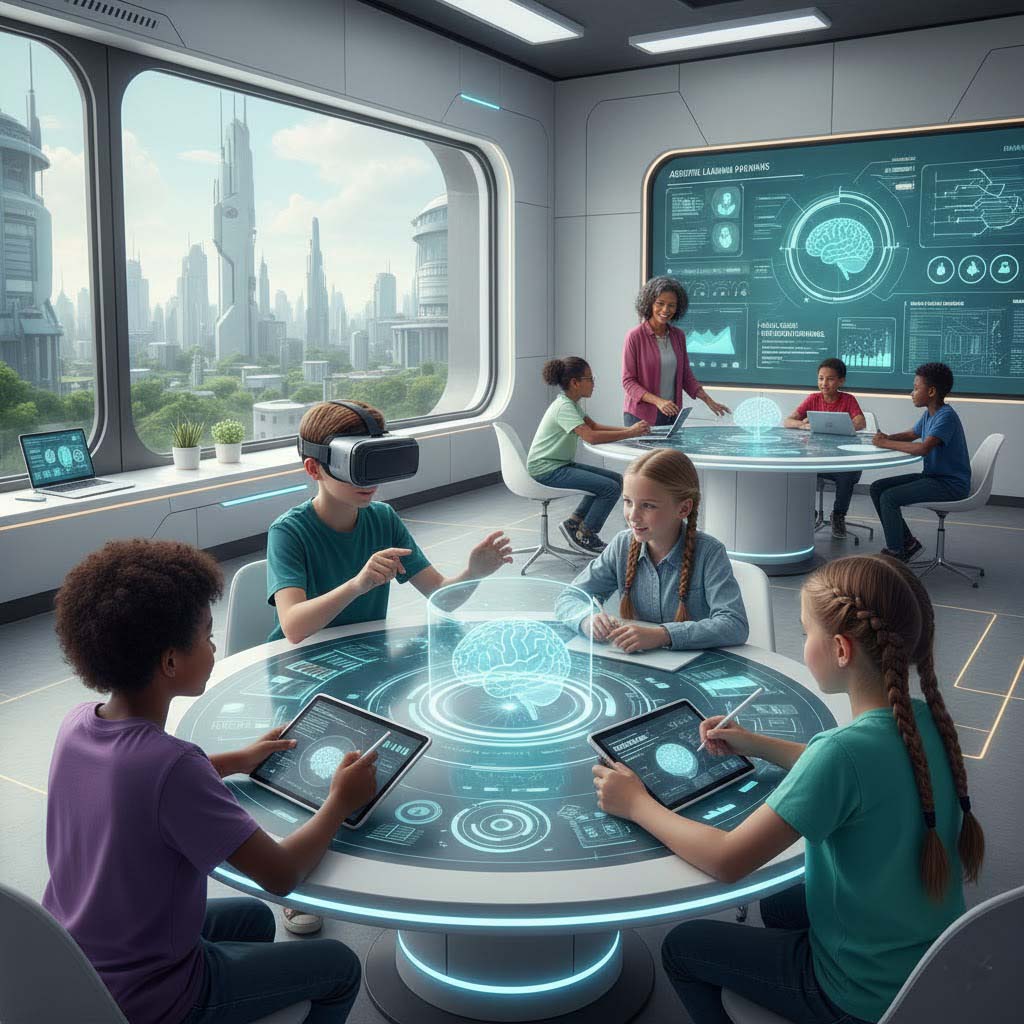
The modern education system most suitable for the AI era is one that shifts focus from content transmission to skills development and personalized, adaptive learning. The goal is not to compete with AI in memorization or calculation, but to train humans to work with AI and excel in uniquely human capabilities.
This is often referred to as a Future-Proof Education Model or an Adaptive Learning System.
Core Pillars of an AI-Era Education
The ideal system is built on two major components: what is taught (the skills) and how it is taught (the methodology).
1. Focus on Human-Centric Skills (The “What”)
Since AI can automate factual recall and most repetitive tasks, the curriculum must prioritize skills that are inherently human and complementary to AI:
- Critical Thinking & Problem Solving: Teaching students to analyze complex situations, evaluate information (especially AI-generated content), and frame the right questions.
- Creativity and Innovation: AI is a tool; humans must provide the vision. The curriculum should emphasize design thinking, artistic expression, and generating novel solutions.
- Emotional Intelligence (EQ) and Ethics: Developing empathy, collaboration, communication, and self-awareness. Students must also learn AI Ethics, bias identification, and the responsible use of powerful technology.
- Computational Thinking & Data Literacy: Not every student needs to be a coder, but everyone needs to understand the logic of algorithms, how data is processed, and how to interpret data-driven insights. This includes prompt engineering (how to effectively communicate with AI).
- Lifelong Learning and Adaptability: The concept of a single, stable career is outdated. The system must foster curiosity and the meta-skill of how to learn new subjects quickly and continuously throughout life.
2. Implementation & Pedagogy (The “How”)
The method of teaching must move away from the industrial, factory-model classroom to a flexible, personalized model.
- Personalized, Adaptive Learning: AI-powered Intelligent Tutoring Systems (ITS) and learning platforms can analyze a student’s performance in real-time and provide tailored content, feedback, and pace—freeing teachers from one-size-fits-all instruction.
- Teacher’s Role: The teacher shifts from a lecturer to a mentor and facilitator, guiding individual student progress and fostering soft skills.
- Project-Based and Interdisciplinary Learning (PBL): Knowledge should be taught through solving real-world, complex problems that require integrating multiple subjects (e.g., combining coding, history, and ethics to design a fictional AI policy).
- Integrate AI as a Tool, Not a Crutch: Students must be taught to use AI tools (like ChatGPT or programming libraries) for research, brainstorming, and drafting, much like a calculator or a word processor, but still master the foundational knowledge.
- Flexible Assessment: Traditional exams that test memory are less relevant. Assessments should focus on application, creation, presentation, and collaborative project outcomes that demonstrate higher-order thinking.
In summary, the most suitable modern education system for the AI era views AI not as a threat, but as an assistant that handles the routine tasks, allowing the human learner to focus entirely on criticality, creativity, and connection.
Technology Tools for an AI-Era Education
1. AI-Powered Adaptive Learning Platforms (For Students)
These are the foundational tools that enable true personalized learning by dynamically adjusting content, pace, and support based on the student’s real-time performance data.
| Tool Type | Description | Key Features & Value |
| Intelligent Tutoring Systems (ITS) | Advanced platforms that mimic a one-on-one human tutor using AI. They contain a detailed Student Model to track knowledge, errors, and learning style. | Personalization: Delivers content (problems, videos, text) tailored to fill specific knowledge gaps. Real-time Feedback: Provides immediate, constructive, and contextual guidance that a teacher cannot scale to every student at once. Scalability: Delivers high-quality, personalized instruction to millions of students simultaneously. |
| Adaptive Assessment Engines | Systems that adjust the difficulty of a quiz or test question-by-question based on the student’s previous answers. | Precise Measurement: Provides a more accurate measure of a student’s true competency than a standard fixed test. Efficiency: Reduces test-taking time by avoiding questions that are either too easy or too hard for the learner. |
| Generative AI Tools (Integrated) | Large Language Models (LLMs) used responsibly as a co-pilot for tasks like research and drafting, embedded within a structured learning environment. | Inquiry-Based Learning: Students use AI to perform rapid research, summarize complex texts, or brainstorm project ideas, moving faster to the critical analysis stage. Prompt Engineering Practice: Students learn how to effectively question and direct an AI, a core literacy skill for the future. |
| Virtual and Augmented Reality (VR/AR) | Tools that create immersive, hands-on learning simulations that would be impossible or unsafe in a real classroom. | Experiential Learning: Allows students to conduct virtual science labs, explore historical sites, or practice engineering tasks in a risk-free environment. Visualization: Helps students visualize abstract or complex concepts (like molecular structure or geological processes) in 3D. |
2. AI Assistant Tools (For Teachers)
The most significant immediate impact of AI is reducing the non-teaching burden on educators, allowing them to focus on mentorship, emotional development, and high-quality human interaction.
| Tool Type | Description | Key Features & Value |
| AI Lesson Plan/Content Generators | Tools (like MagicSchool AI or Brisk Teaching) that use AI to instantly create, differentiate, or adjust instructional materials. | Differentiation: Instantly convert a single lesson into multiple versions based on reading levels (e.g., for different student needs), language, or complexity. Time Savings: Generate draft quizzes, lesson plans, rubrics, and educational games in minutes, freeing up hours per week for teachers. |
| Automated Grading and Feedback Systems | AI-driven tools that can read and provide objective feedback on low-stakes assignments and essays. | Consistent Feedback: Provides faster, more objective feedback on basic mechanics and structure, allowing the teacher to focus their feedback on higher-order thinking (creativity, argument quality, ethics). Data Insights: Flags common student misconceptions across the class, informing the teacher on where they need to reteach or intervene. |
| Learning Management System (LMS) Analytics | AI integrated into the school’s LMS (like Google Classroom or Blackboard) to analyze student data and predict learning issues. | Early Warning Systems: Identifies students who are likely to fail or disengage before it’s too late, allowing the teacher to intervene proactively. Curriculum Improvement: Provides data-driven insights into which parts of a curriculum are most effective and which need revision. |
The key takeaway is that in the AI era, technology should be the engine of personalization and efficiency, while the human teacher remains the chief architect of creativity, emotional intelligence, and ethical reasoning.